
Monday, October 27, 2008

Thursday, October 23, 2008

Tuesday, October 21, 2008
Constructional Activities

The old Naga Hammadi Barrage, the middle one of three such structures constructed between 1900 and 1930 along the Nile River in Upper Egypt, is located 130km north of the city of Luxor and 360km downstream of the Aswan Dam, which was completed in 1963. This reservoir feeds an agricultural irrigation system, thus securing year-round cropping of 32 0,000ha
 0,000ha
Naga Hammadi Barrage
Saturday, October 18, 2008
Ancient Egyptian Temple Entrance Found in Nile River

Archaeologists have discovered a portico, or covered entryway, of an ancient Egyptian temple beneath the surface of the Nile River.
The entryway once led to the temple of the ram-headed fertility god Khnum, experts say.
A team of Egyptian archaeologist-divers found the portico in Aswan while conducting the first-ever underwater surveys of the Nile, which began earlier this year.
"The Nile has shifted, and this part of the temple began to be a part of [the river]," said Zahi Hawass, Secretary General of Egypt's Supreme Council of Antiquities.
Surviving Time
The massive portico is too large to be removed during the current excavation, but archaeologists removed a one-ton stone with inscriptions that could date from the 22nd dynasty (945-712 B.C.) to 26th dynasty (664-525 B.C.).
The stone itself could be much older, however, because like many objects throughout Egyptian history, the original materials of the Temple of Khnum were reused to construct newer buildings.
The temple of Khnum was first erected in the 12th dynasty (1985-1773 B.C.) or 13th dynasty (1773-1650 B.C.) and was later rebuilt and expanded under subsequent regimes, including by the "female pharaoh" Hatshepsut (1473-1458 B.C.)
Ancient Nile (From an ancient Egyptian Article)
INNUDATION
The Nile River has always been the backbone of Egypt. The mighty river flows for some 4,000 miles from the mountains of Equatorial Africa (Blue Nile) and Lake Victoria (White Nile) before it empties into the Mediterranean Sea. Without the Nile River and its annual inundation Ancient Egypt would never have come into being. Its fertile valley was renewed every year with rich silt deposits laid down during the flooding.
Nilometers were placed at various points along the Nile in order to monitor the changes in the water level. It was recorded that at the start of the flooding the clear waters would turn a turbid red.
As the agriculture of Egypt revolved around the Nile, so did the social life of the ancient Egyptians. During inundation when there was less to do, people had more time for recreational activities, they played games, held sporting tournaments and regularly feasted.
When the River Nile receded the appearance of the land had radically changed and there was a great rush to restore boundaries. There were many disputes as markers had moved, banks had collapsed, and distinguishable features had disappeared.
TRANSPORT
The river was also the chief means of transport.It was their highway, making roads superfluous, except between close villages. Virtually everything moved by boat.
FOOD AND SPORT
The Nile, for the most part, is a gently flowing river and in the time of the ancients, was crammed with fish. It’s easy flow made fishing very popular. Everyone enjoyed fishing, from the young to old, peasant to noble.
RELIGION
The Egyptians believed that the Nile was the centre of the world. And the place from which it originated was, ‘the beginning of the world’. In Lower Egypt, in the area of the Nile Delta, the river splits into two great arms. The area between the two was densely populated from the earliest times. Many of the major cult centres developed in this region. Even the soul of a deceased had to cross the Nile before he could enter the kingdom of the dead.
SUMMARY
The ancients utilised every aspect of the river, and the achievements of both man and the Nile down the ages, deserves praise. The River Nile was the fundamental and protecting force of a great nation. Of all the great rivers, the Nile blessed its people with the most reliable and predictable cycle of seasons.
The Nile River has always been the backbone of Egypt. The mighty river flows for some 4,000 miles from the mountains of Equatorial Africa (Blue Nile) and Lake Victoria (White Nile) before it empties into the Mediterranean Sea. Without the Nile River and its annual inundation Ancient Egypt would never have come into being. Its fertile valley was renewed every year with rich silt deposits laid down during the flooding.
Nilometers were placed at various points along the Nile in order to monitor the changes in the water level. It was recorded that at the start of the flooding the clear waters would turn a turbid red.
As the agriculture of Egypt revolved around the Nile, so did the social life of the ancient Egyptians. During inundation when there was less to do, people had more time for recreational activities, they played games, held sporting tournaments and regularly feasted.
When the River Nile receded the appearance of the land had radically changed and there was a great rush to restore boundaries. There were many disputes as markers had moved, banks had collapsed, and distinguishable features had disappeared.
TRANSPORT
The river was also the chief means of transport.It was their highway, making roads superfluous, except between close villages. Virtually everything moved by boat.
FOOD AND SPORT
The Nile, for the most part, is a gently flowing river and in the time of the ancients, was crammed with fish. It’s easy flow made fishing very popular. Everyone enjoyed fishing, from the young to old, peasant to noble.
RELIGION
The Egyptians believed that the Nile was the centre of the world. And the place from which it originated was, ‘the beginning of the world’. In Lower Egypt, in the area of the Nile Delta, the river splits into two great arms. The area between the two was densely populated from the earliest times. Many of the major cult centres developed in this region. Even the soul of a deceased had to cross the Nile before he could enter the kingdom of the dead.
SUMMARY
The ancients utilised every aspect of the river, and the achievements of both man and the Nile down the ages, deserves praise. The River Nile was the fundamental and protecting force of a great nation. Of all the great rivers, the Nile blessed its people with the most reliable and predictable cycle of seasons.
Nile-What are its branches?
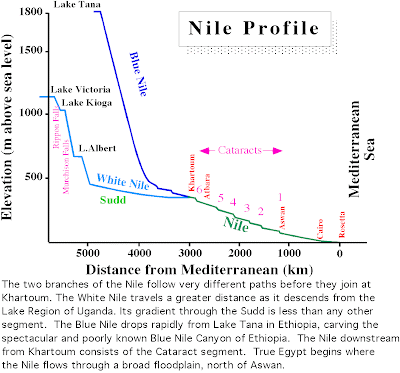
The Nile consists of two principal branches - the White Nile and the Blue Nile - which join at Khartoum to form the main Nile. The main Nile consists of the Egyptian Nile and the Cataract Nile. The White Nile, which is the longest segment, may be further subdivided into: 1) The Central Sudan region; 2) The Sudd; and 3) the Lake Plateau region.

Subscribe to:
Posts (Atom)